Standard Business Voice
Everyday calling
Consider
Normal inbound + outbound
For offices with normal inbound and outbound calling requirements.
Capacity inputs
Reception activity
Employee count
Peak concurrent calls
Business hours
If your existing phone system still works for the business, you may not need to replace it just to modernise your calling.
C9 designs and manages SIP trunking around your existing phone system, business numbers, call volumes, connectivity and future voice plans.
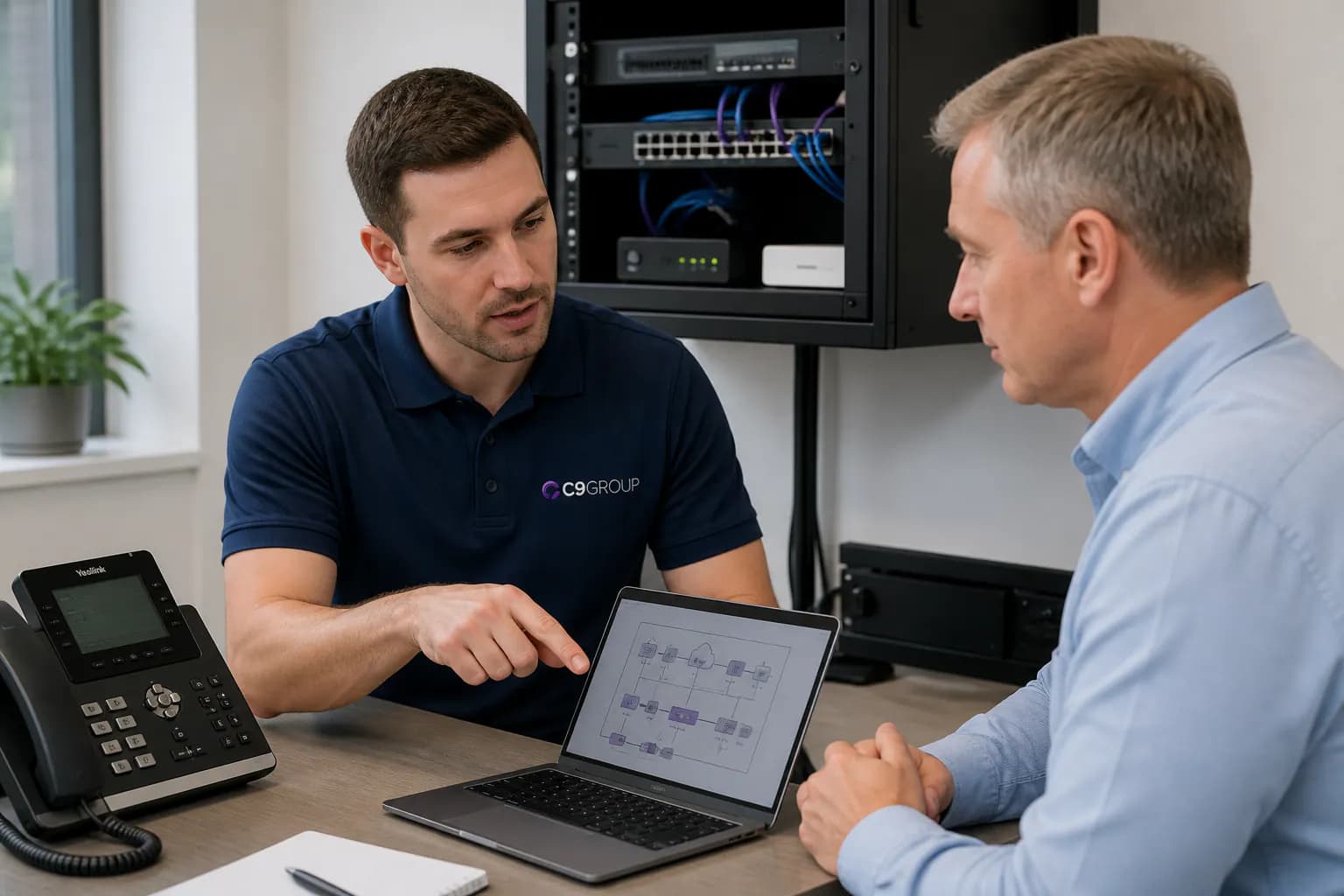











C9 reviews the PBX, numbers, call capacity, connectivity, network readiness and future voice plans before recommending a SIP path.
SIP Trunking should solve the actual voice requirement: retain a working PBX, replace an underlying service, increase capacity or prepare for a future cloud transition.
Current PBX
Keep the compatible phone system and modernise the voice connectivity behind it.
Service replacement
Review the current phone numbers, PBX, network and calling requirements before changing services.
Call capacity
Size SIP capacity around peak call volumes instead of simply counting phones or extensions.
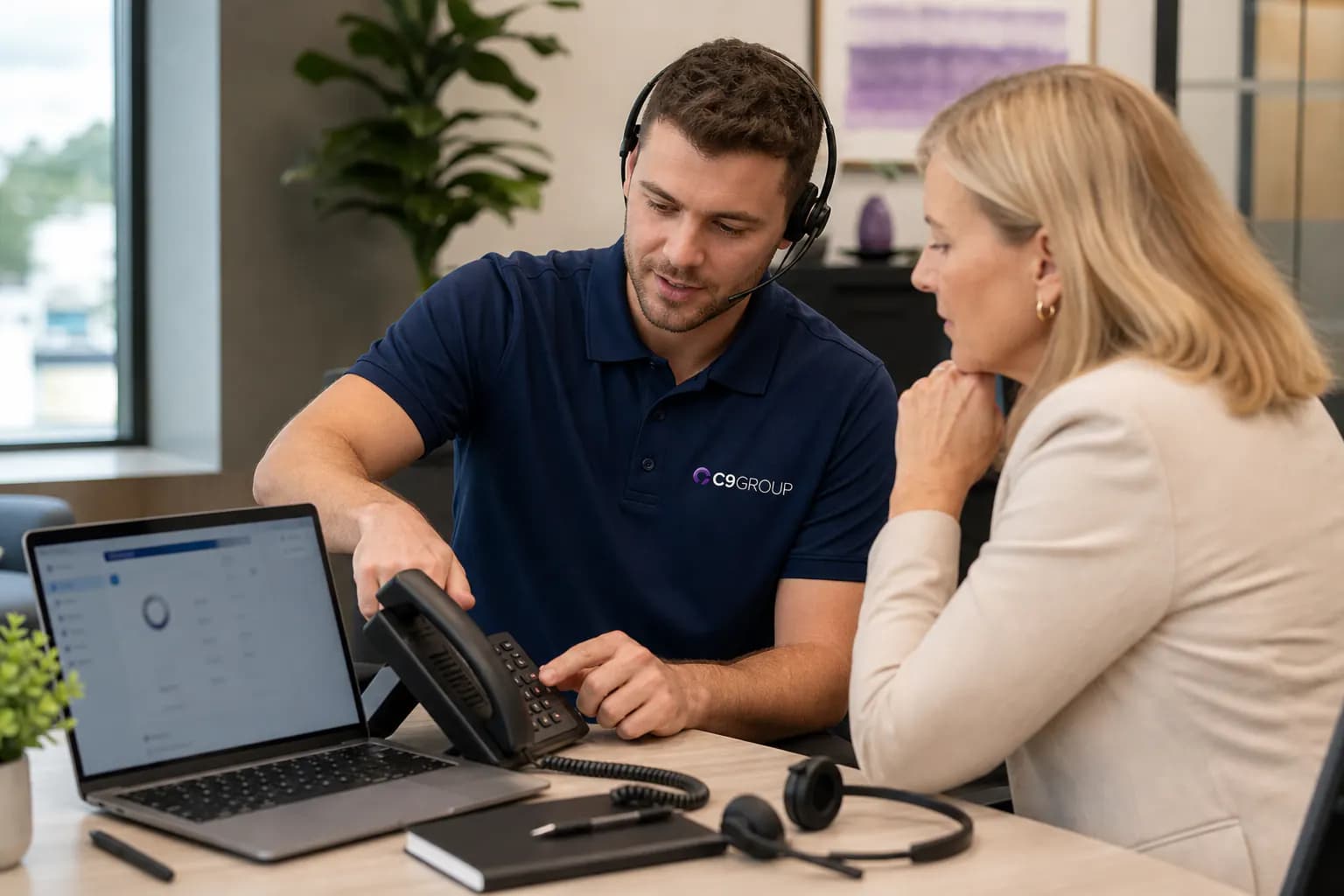
The SIP service matters. But so do the PBX, business internet connection, firewall, phone numbers, call routing and future voice direction.
The service matters, but so do the PBX, business internet connection, firewall, numbers and call routing.
C9 identifies important numbers, where calls need to go, and what should happen when requirements change.
If Teams Phone or cloud calling is coming later, C9 can assess whether SIP should support that transition.
C9 compares existing PBX + SIP, multi-site SIP and future cloud or Teams pathways before recommending the next step.
For businesses with a compatible phone system that still meets their operational needs. Keep the PBX and replace the underlying voice connectivity.
For businesses that need voice services across multiple offices, stores, clinics or operating sites.

For organisations planning to retire the existing PBX and move towards Microsoft Teams Phone or another cloud voice platform.
The number of employees is not the same thing as the number of simultaneous calls. C9 looks at peak calling behaviour before recommending capacity.
See FAQEveryday calling
Consider
Normal inbound + outbound
For offices with normal inbound and outbound calling requirements.
Capacity inputs
Higher inbound
Consider
Queues + peak periods
For organisations with higher inbound activity across sales, service or operational teams.
Capacity inputs
Complex capacity
Consider
Sites + continuity
For more complex environments where multiple sites or higher concurrent calling volumes need to be accommodated.
Capacity inputs
C9 confirms available SIP services, channel requirements, call inclusions, number requirements and commercial terms after reviewing your existing environment.
C9 reviews the PBX, number inventory, concurrent call needs, connectivity, firewall configuration and continuity requirements before the service moves.
The existing phone system should be reviewed before a SIP service is ordered.
Know which main numbers, direct numbers and number ranges are active before migration planning begins.
Capacity should be based on expected simultaneous calling rather than extension count alone.
Voice relies on the IP path carrying it. Available bandwidth, latency and network behaviour need to be considered.
SIP configuration needs to work correctly with the network and existing telephony environment.
Important inbound calls should have an agreed routing approach for relevant outage scenarios.
A business voice problem can originate in several places, which is why C9 assesses the calling path rather than treating SIP as an isolated product.
Bandwidth, latency and stability affect the voice path.
Local configuration can change the experience even when the SIP service is healthy.
Compatibility and configuration need to match the proposed voice service.
The trunk connects the phone environment to external calling.
Phones, headsets and user behaviour still influence call experience.
C9 recommendation
If the business relies on voice for sales, service, bookings or operations, C9 reviews the full path: SIP service, PBX, network, connectivity, routing and continuity.
Use this as the decision matrix before replacing a phone system that may still be useful.
Existing PBX
Compatible PBX can be retained.
Existing architecture remains unchanged.
Call capacity
Sized around concurrent calling requirements.
Often tied to historical service configuration.
Number migration
C9 manages the agreed migration process.
Customer coordinates.
Network readiness
Connectivity and local network are considered.
Often treated separately.
Call routing
Routing requirements reviewed during design.
Existing configuration only.
Future migration
Teams/cloud direction can be considered now.
Separate future project.
Support
C9 provides one managed-service relationship across applicable components.
Voice and network may sit with separate parties.
The value is getting the complete calling environment from its current state into a supportable one, with PBX, network, numbers and routing handled together.
Assess: PBX, network, numbers and call requirements.
Design: SIP service, capacity, routing and continuity.
Migrate: Coordinate service and eligible number transition.
Validate: Test important inbound and outbound call behaviour.
Manage: Keep one C9 contact path for the voice services under management.
Replacing the whole phone system is not automatically the right answer.
Numbers, dependencies and call flows are reviewed before the cutover is scheduled.
C9 can assess the network environment supporting the phone service rather than looking at the carrier connection in isolation.
When the business is ready for Microsoft Teams Phone or another cloud calling environment, the wider voice roadmap can be reviewed.
C9 remains involved across the services it manages instead of handing the business a SIP username and walking away.
Review PBX, business numbers, existing voice service, connectivity and call requirements.
Confirm architecture, concurrent capacity, routing and migration requirements.
Configure the agreed environment and coordinate number-porting requirements.
Move the agreed services and validate important inbound and outbound calling.
Keep C9 involved for support, changes, capacity reviews and future voice requirements.
ACTIVE STAGE
Audit
Review PBX, business numbers, existing voice service, connectivity and call requirements.
Choose which optional analytics and live chat tools C9 GROUP may use. You can change this later from the footer.